Current Location: In storage
Titles
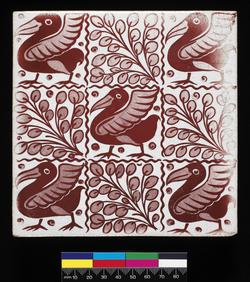
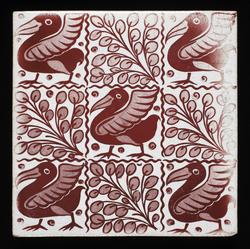
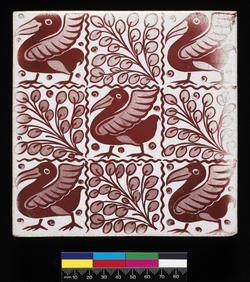
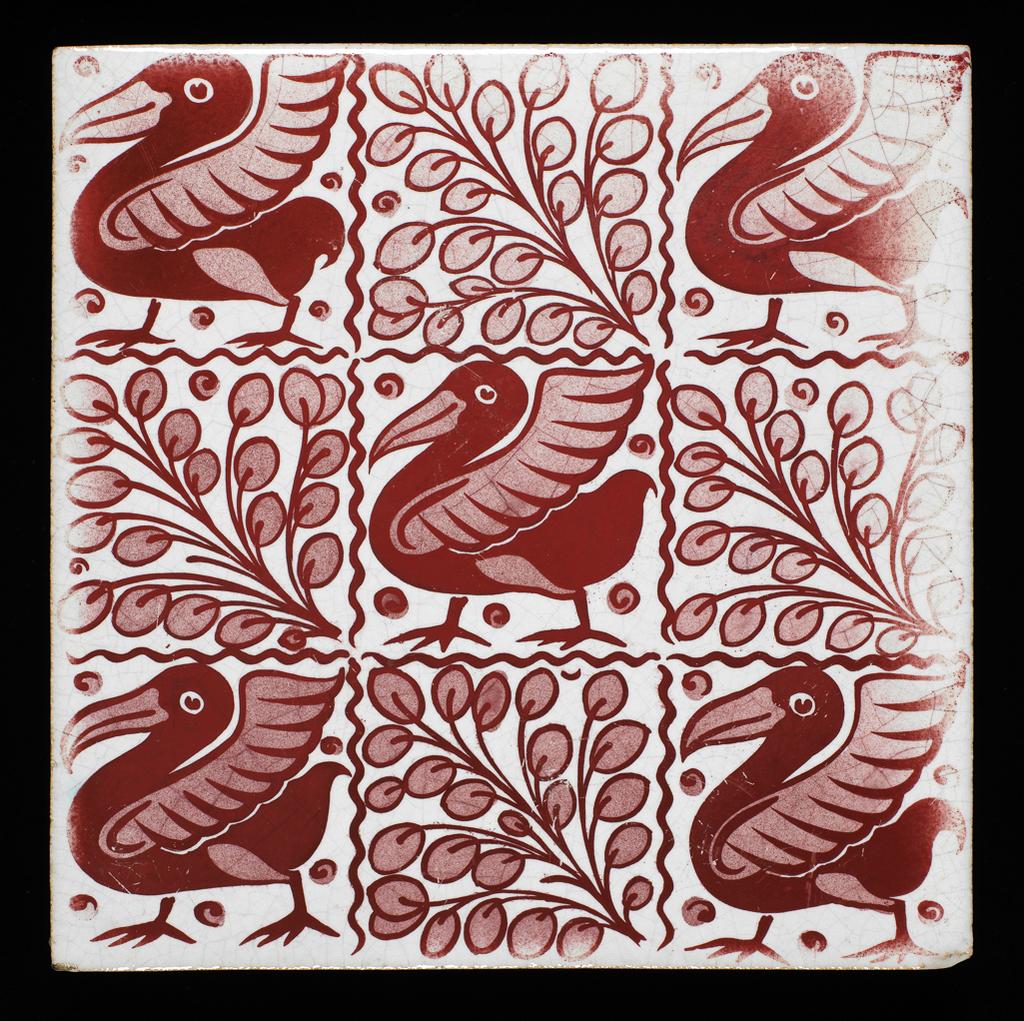
Tile with five ruby birds
Maker(s)
Maker:
William De Morgan & Co.
Designer:
De Morgan, William Frend
Entities
Categories
Description
Square buff earthenware tile, covered with white slip and decorated with ruby and pink lustre. Divided into nine squares, alternating large-beaked birds with beady eye and raised wing and box-tree sprays. The earthenware is quite coarse and the sides of the tile rough and unglazed.
Notes
History note: Given by Mr H C Mossop, 1941
Legal notes
Given by Mr H C Mossop
Measurements and weight
Width: 15.5 cm
Width: 6.125 in
Acquisition and important dates
Method of acquisition: Given
(1941-03-26)
by
Mossop, H. C.
Dating
19th Century, Late
1888
CE
-
1898
CE
Note
William Frend De Morgan (1839-1917), now widely regarded as the most important ceramicist of the Arts & Crafts movement, also worked in stained glass and became a successful novelist. The son of a non-conformist mathematics professor, he became a close friend of William Morris and Edward Burne-Jones and married the Pre-Raphaelite painter Evelyn Pickering (1855-1919), in 1887. As a ceramicist, De Morgan was primarily a designer/decorator and chemist, working on bought-in blanks or pots thrown to his design. He experimented widely with techniques and glazes, re-discovering methods for making and applying lustres and the colours of Iznik and Persian pottery and using them for a range of complex fantasy designs featuring ships, birds, flora and animals. This design dates from 1872-81, when De Morgan was first producing lustre-ware in Chelsea. The tile was made later, at Sands End, Fulham, when he was in partnership with the architect Halsey Ricardo. The coarse earthenware and rough sides indicate that the tile was intended for a fireplace or other architectural use. De Morgan made many, many designs for tiles and tile panels – some 820 are in the V&A collection.
School or Style
Arts and Crafts (movement)
People, subjects and objects depicted
Components of the work
Decoration
composed of
lustre
( pink and ruby)
clear glaze
Materials used in production
coarse, buff-coloured
Earthenware
Techniques used in production
Slip-coating
: Earthenware, slip-coated, glazed and decorated with lustre
Inscription or legends present
Inscription present: in a circle surrounding a rosette
- Text: SANDS END POTTERY - FULHAM - WM.DE MORGAN & CO.
- Location: On reverse
- Method of creation: Impressed
- Type: Mark
- Text: 5/1941
- Location: On reverse
- Method of creation: Circular white paper, handwritten in black ink
- Type: Label
References and bibliographic entries
Identification numbers
Accession number: EC.5-1941
Primary reference Number: 15315
Stable URI
Audit data
Created: Saturday 6 August 2011
Updated: Friday 8 August 2025
Last processed: Friday 8 August 2025
Associated departments & institutions
Owner or interested party:
The Fitzwilliam Museum
Associated department:
Applied Arts
 Mirador deep zoom
 IIIF Manifest