Awaiting location update
Maker(s)
Production:
Unknown
(Uncertain)
Entities
Categories
Description
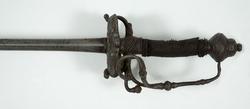
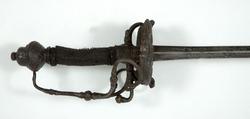
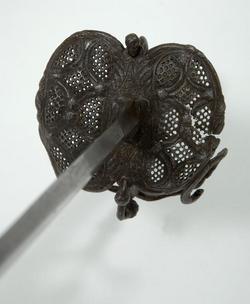
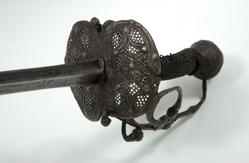
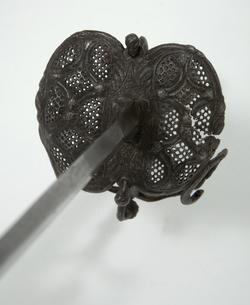
Rapier. Large urn-shaped pommel with button, the upper part chiselled with leaves, the lower with spiralling ridges. Grip of very fine wire, woven in basket-fashion with Turks' heads at top and bottom. Narrow, angular knuckle-guard, with a knob below the midpoint from beneath which spring single loop-guards, one on each side of the hilt, joining the upper edges of a double shell-guard; each loop-guard ends, where it touches the edges of the shells, in a strong upward scroll. Each of these loop-guards has a triple knob at its midpoint. Short quillons (the rear one missing) with a very large rectangular quillon-block, and knobbed ends. The surviving one (on the front of the hilt) turns sharply upward to meet the lower curve of the knuckle-guard. Shallow arms, supporting the double shell, turned outward in the spaces where the edges of the two shells meet. These shells, chiselled with a pattern of overlapping scales pierced with small holes have rims fashioned in the same manner as the loop-guards. Inside the hilt, the ricasso is covered by a rectangular iron sleeve, chiselled with a kind of double and motif.
Narrow blade, of diamond section, the faces hollowed out.
Norman hilt type 96 (variant).
Legal notes
J.S. Henderson Bequest
Measurements and weight
Length: 104.2 cm
Acquisition and important dates
Method of acquisition: Bequeathed
(1933-03-16)
by
Henderson, James Stewart
Dating
17th Century
Circa
1640
CE
-
1670
CE
Note
There is a band of quite heavy corrosion along the blade about 1/3 of the way below thehilt, and the grip's wooden core has entirely perished, leaving the copper wire binding like an empty husk.
Components of the work
Grip Core
composed of
wood (plant material)
( almost perished)
Grip Binding
composed of
copper
( wire)
Ricasso Sleeve
composed of
iron (metal)
Hilt
Length 17 cm
Blade
Length 86.3 cm
Decoration
Sword
Materials used in production
Steel
Identification numbers
Accession number: HEN.M.243-1933
Primary reference Number: 18988
Stable URI
Audit data
Created: Saturday 6 August 2011
Updated: Monday 29 April 2024
Last processed: Tuesday 13 May 2025
Associated departments & institutions
Owner or interested party:
The Fitzwilliam Museum
Associated department:
Applied Arts

 Mirador deep zoom
 IIIF Manifest