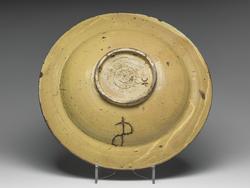
Current Location: Gallery 6 (Upper Marlay): case 2, shelf C
Maker(s)
Maker:
Unidentified Deruta pottery
Entities
Categories
Description
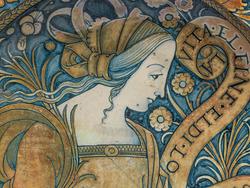
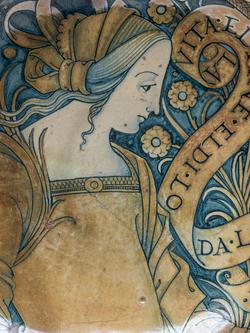
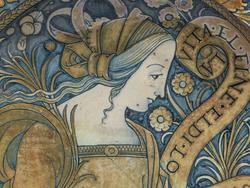
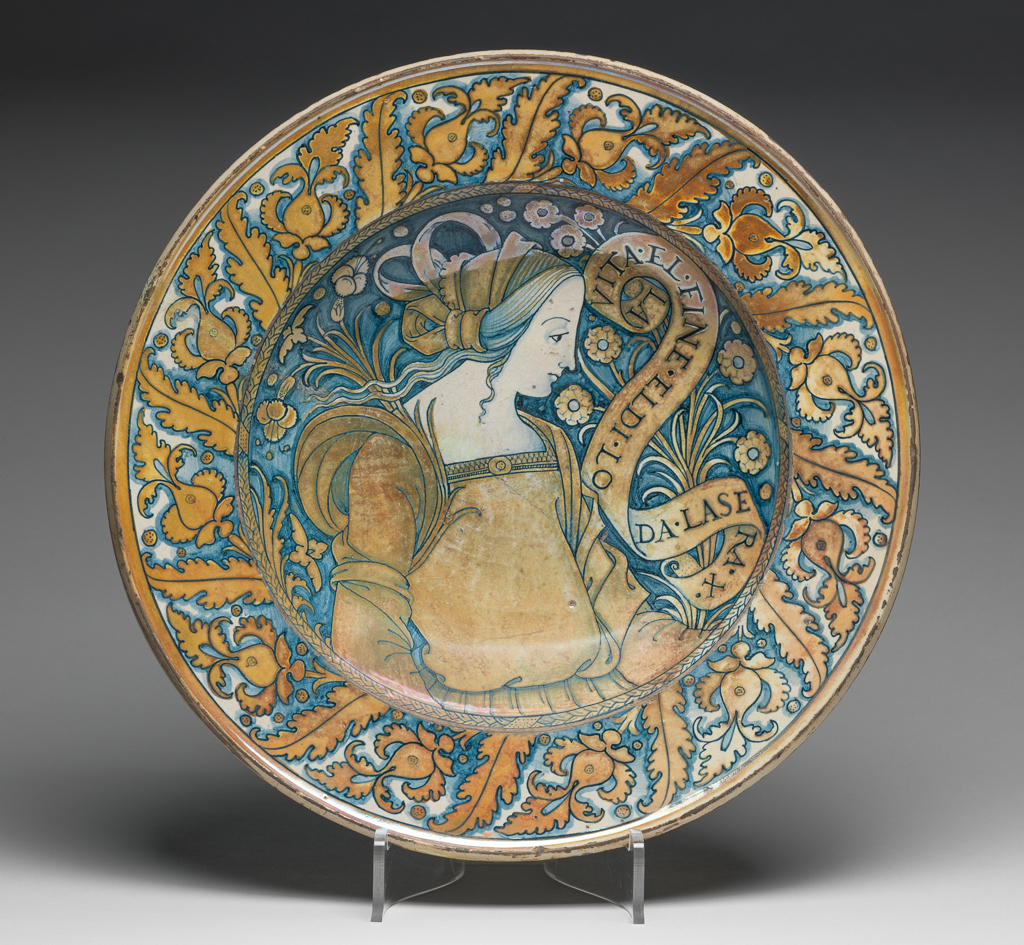
Tin-glazed earthenware painted in blue and lustred with a half-length figure of a young woman in profile to right facing a coiled scrole inscribed 'LA VITA.EL.FINE.ELDI.LO DA.LASE RA.X.' (Life by its end, day by the evening, is praised), surrounded by a border of leaves and stylized flowers.
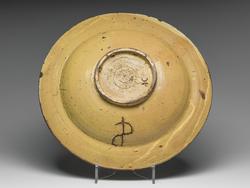
Earthenware, the front is tin-glazed; the reverse has thick, opaque, dark yellow lead-glaze. Painted in thinly applied dark blue and with pale silver-yellow lustre. Shape 61. Circular, with slightly sloping rim, and wide deep well, standing on a footring pierced by three incorrectly placed suspension holes. In the well, a young woman, half-length with her head in profile to right, faces a coiling scroll, inscribed 'LA VITA.EL.FINE.ELDI.LO DA.LASE RA.X.' (Life by its end, day by the evening, is praised). There are formal flowers in the background, and bound laurel round the edge of the well. On the rim, slanting serrated leaves alternate with stylized flowers. A band of yellow lustre encircles the outer edge.
Notes
History note: Max Goldschmidt-Rothschild; Kurt Glogowski, Berlin; sold Sotheby's, 8 June 1932, Catalogue of the well-known collection of important Italian majolica, also bronzes and statuary, velvets, textiles and embroideries, fine Oriental rugs, & c. the property of Herr Kurt Glogowski of Berlin, lot 30.
Legal notes
Purchased with the Glaisher Fund
Measurements and weight
Height: 7.5 cm
Acquisition and important dates
Method of acquisition: Bought
(1932-06-08)
by
Sotheby's
Dating
16th Century, Early
Circa
1500
CE
-
Circa
1530
CE
Note
The girl is painted in the style of Pietro Perugino (active 1472-1523) and closely resembles the Eritrean Sibyl in his fresco of 'God the Father announcing the Salvation' in the Sala dell'Udienza in the Collegio del Cambio, Perugia, painted between 1496 and 1500. Similar young women appear in paintings by Pinturicchio (1454-1513) such as in the' Visitation' in the Borgia apartments of the Vatican, but Deruta maiolica painters were more likely to have seen or had access to drawings after local works in nearby Perugia. It was a popular prototype for the decoration of large dishes decorated with busts or half-length figures of women, known today as bella donna dishes. These are thought to have been presented to women by their betrothed or husband, and a few examples show a couple together. At least thirty-five examples based on the same prototype are known, the majority showing the girl facing to the left, and a few to the right, as here, and in the Cleveland Museum of Art, Ohio (1951.327), the Metropolitan Museum of Art, New York (1953.225.87), and the Chigi-Saraceni collection, Siena (FAC.Inv. no. 61). There are no dated examples decorated with similar designs, but it seems probable that this slender, chaste ideal of womanhood con¬tinued to be represented by Deruta painters until at least the 1520s.
Many of these dishes have a scrolling ribbon or label behind the girl, bearing a name followed by Bella or another adjective, or have a proverb, saying, or quotation from the bible or literature. The inscription on this dish was taken from Petrarch's, Le Rime, XXIII, 31, `La vita el fin e 'l di loda la sera' ' (Life by its end, day by the evening, is praised). Variants of this line occur on dishes with the same girl in the the Metropolitan Museum of Art, New York (94.4.320), and the Musée National de la Renais¬sance, Écouen (E.C1.2430), and on a dish decora¬ted with a different girl, in the Museo Nazionale di Ravenna.
The dishes had a wide variety of border patterns. This dish has one of the most unusual; designs of slanting leaves and stylized flowers, radiating from the the edge of the well, which also occurs on a dish decorated with warrior in the Kunstgewerbe¬museum, Cologne (E 2110).
School or Style
Renaissance
People, subjects and objects depicted
Components of the work
Decoration
composed of
high-temperature colour
( cobalt-blue)
reduced pigment lustre
( silver-yellow lustre)
Back
composed of
lead-glaze
Front
composed of
tin-glaze
Rim
Diameter 39.5 cm
Materials used in production
Earthenware
Techniques used in production
Throwing
: Earthenware, the front is tin-glazed; the reverse has thick, opaque, dark yellow lead-glaze. Painted on the front in thinly applied dark blue and with pale silver-yellow lustre
Inscription or legends present
- Text: a figure 8
- Location: On underside of well
- Method of creation: Incised through the glaze
- Type: Inscription
- Text: LA VITA.EL.FINE.ELDI.LO DA.LASE RA.X.
- Location: On front
- Method of creation: Painted in blue
- Type: Inscription
References and bibliographic entries
-
Catalogue of the Glaisher Collection of Pottery and Porcelain in the Fitzwilliam Museum Cambridge
page(s): 285
-
Guide to the European Pottery and Porcelain in the Fitzwilliam Museum Cambridge
page(s): 53
-
The Concise Encyclopedia of Continental Pottery and Porcelain
-
Italian Maiolica
-
Ceramic Art of the World, XXII, European Ceramics
page(s): p. 58
-
Treasures from the Fitzwilliam: ''The Increase of Learning and other great Objects of that Noble Foundation''
page(s): 42
-
Italian Maiolica and Incised Slipware in the Fitzwilliam Museum Cambridge
page(s): 166-8
-
Fitzwilliam Museum Handbooks, Italian Maiolica
page(s): 36-7
-
When is a portrait not a portrait,? Belle Donne on Maiolica and the Renaissance Praise of Local Beauties
page(s): 145, 152
-
Le Rime
page(s): 26
-
Petrarch's Lyric Poems, The Rime sparse and other Lyrics
page(s): 60
-
Fonti iconografiche e stilistiche della decorazione nella maiolica rinascimentale
page(s): 25-57
-
Monte dei Paschi di Siena, Collezione Chigi Saracini, 5, Maioliche Italiane
page(s): 164-66
-
La ceramica umbra al tempo di Perugino
page(s): 110
-
Fati di Ceramica nelle Marche dal Trecento al Novecento
page(s): 32
-
Ideal Brides: Deruta Bella Donna Plates 1500-1550. Courtship, Marriage and Decorative Art in Renaissance Italy
page(s): 179-82
-
Victoria and Albert Museum, Catalogue of Italian Maiolica
page(s): 158
-
Le maioliche del Museo Nazionale di Ravenna
page(s): 83
-
Ceramiche dalle Collezioni del Museo Nazionale di Ravenna
page(s): 65-6
-
Kataloge des Kunstgewerbemuseums der Stadt Köln, II, Majolika
page(s): 162
-
Maiolica: Italian Renaissance Ceramics in the Metropolitan Museum of Art
page(s): 242-3
-
The Golden Age of Maiolica-Painting. Catalogue of a Private Collection
page(s): 106-07
Related exhibitions
Identification numbers
Accession number: C.24-1932
Primary reference Number: 47190
Glaisher additions number: Gl.Add.42-1932
Stable URI
Audit data
Created: Saturday 6 August 2011
Updated: Tuesday 16 September 2025
Last processed: Tuesday 16 September 2025
Associated departments & institutions
Owner or interested party:
The Fitzwilliam Museum
Associated department:
Applied Arts
 Mirador deep zoom
 IIIF Manifest