Current Location: In storage
Titles
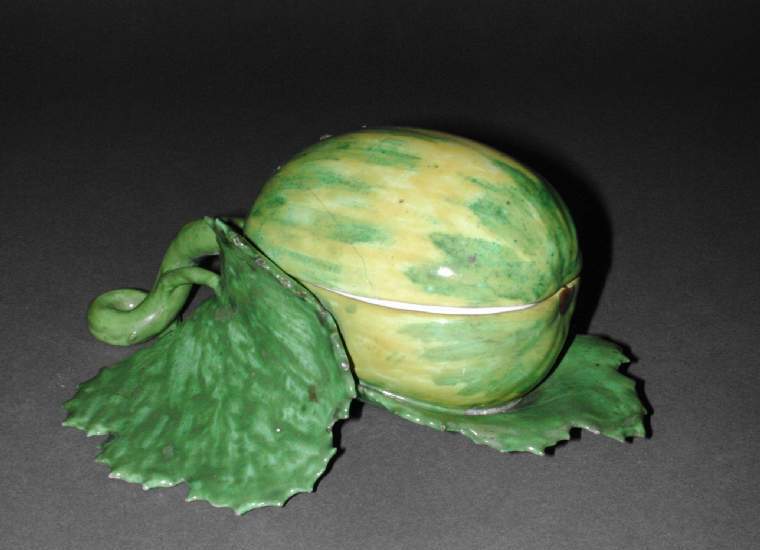
Box in the form of a melon
Maker(s)
Production:
Hannong factory
(Perhaps)
Entities
Categories
Description
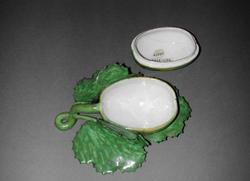
Tin-glazed and painted earthenware in the form of a melon on a stem with three leaves three leaves
Earthenware, tin-glazed overall, and painted naturalistically in yellow, two shades of green, and brown enamels. The oval melon is growing on a tubular stalk with three large leaves, one of which is under the fruit, and has a slight projection in the middle serving as a foot.
Notes
History note: Miss Kingsland, Croydon, from whom bought in February 1900 by Dr J.W.L. Glaisher, FRS, Trinity College, Cambridge
Legal notes
Dr J. W. L. Glaisher Bequest
Measurements and weight
Length: 21.5 cm
17.9
8.8
At the moment, this record does not display units or type of
measurements. We will rectify this as soon as possible.
Acquisition and important dates
Method of acquisition: Bequeathed
(1928-12-07)
by
Glaisher, J. W. L., Dr
Dating
18th Century, Mid
Paul Hannong Period
1748
-
1754
Note
Ceramic tableware in the form of fruit, vegetables or animals was intended to deceive and delight diners. The great period for its manufacture was between about 1745 and 1775, when a pan-European passion for fruit and vegetable gardening coalesced with the fashion for naturalistic decoration as an aspect of the playful Rococo style. The craze probably began at the Meissen porcelain factory in Saxony, where compotiers (for stewed fruit) in the form of artichokes and sunflowers with handles, were already in production by the late 1740s. Within a few years porcelain tableware in deceptively naturalistic forms was being made by other porcelain factories, such as the Chelsea and Longton Hall in England. Less expensive versions were produced in tin-glazed earthenware (faïence) by factories in many Continental cities, such as Brussels, Delft, and Strasbourg. The Hannong factory in Strasbourg produced some of the finest examples between 1748-54 during the directorship of Paul Hannong. The attribution of his melon to the Hannong factory is uncertain.
School or Style
Rococo
Components of the work
Decoration
composed of
enamels
( yellow, two shades of gree, and brown)
Surface
composed of
tin-glaze
Leaves
Materials used in production
Earthenware
Techniques used in production
Press moulding
: Buff earthenware, pressmoulded, hand modelled, tin-glazed, and painted in yellow, two shades of green, and brown enamels
References and bibliographic entries
Identification numbers
Accession number: C.2365 & A-1928
Primary reference Number: 73406
Old object number: 1053
Stable URI
Audit data
Created: Saturday 6 August 2011
Updated: Monday 1 December 2025
Last processed: Monday 1 December 2025
Associated departments & institutions
Owner or interested party:
The Fitzwilliam Museum
Associated department:
Applied Arts