Current Location: Gallery 27 (Glaisher)
Maker(s)
Pottery:
Unidentified Staffordshire Pottery
Entities
Categories
Description
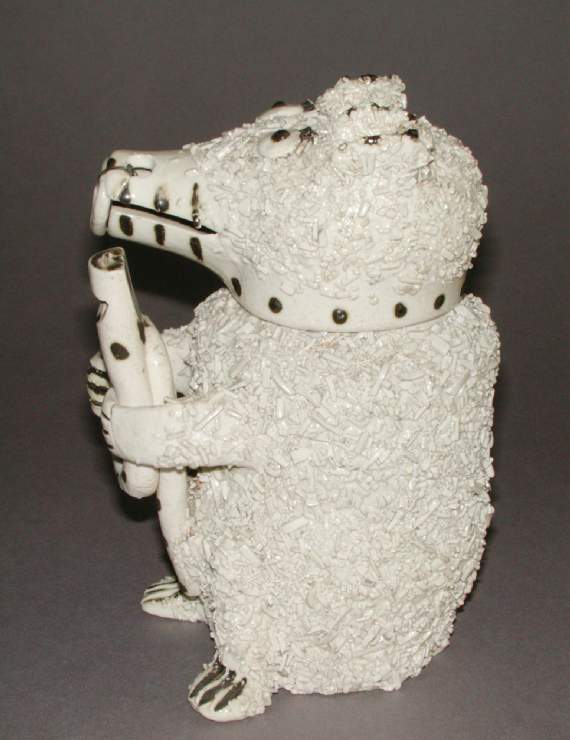
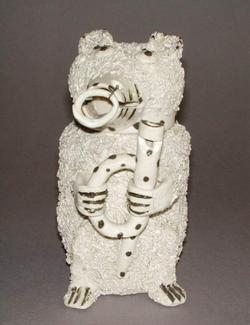
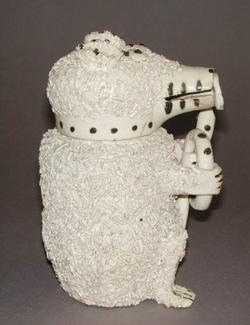
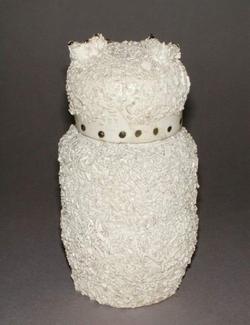
White salt-glazed stoneware container in the form of a bear with furof applied shreds of clay, and details applied in brown slip
White stoneware, thrown in two parts with applied ears, muzzle, and limbs, covered with coarse shreds of clay to imitate fur, decorated with dark brown slip details, and salt-glazed. The bear is sitting upright holding a functional coiling whistle in its forepaws. It has a tubby body and a separate head which serves as a cup. In its snout it has a salt-glazed stoneware ring attached by a piece of metal wire. Brown slip has beeen applied in short stripes on the paws, and muzzle, and in spots on the whistle, round the lower part of the head, and on the ears. The eyes are formed by two circles of white clay with a brown slip spot in the centre and two short brown lines above.
Notes
History note: Puttick & Simpson, London, 24 June 1921, lot 59; sold to Mack for £4.4s. bidding on behalf of Dr J.W.L. Glaisher, FRS, Trinity College, Cambridge, who fetched it to Cambridge on 6 July
Legal notes
Dr J.W.L. Glaisher Bequest
Measurements and weight
Depth: 12.1 cm
Height: 17.2 cm
Acquisition and important dates
Method of acquisition: Bequeathed
(1928-12-07)
by
Glaisher, J. W. L., Dr
Dating
18th Century, Mid
George II
Circa
1740
CE
-
1770
CE
Note
This bear jug is unusual because it holds a functional whistle, see Documentation for another. It is assumed that bears like this were for alcoholic liquor and that their heads served as cups. No contemporary illustrations of them in use have been found. Nor are dated examples known, but it seems likely that they were made between about 1740 and 1770, when white salt-glazed stoneware was most popular.
Components of the work
Decoration
composed of
slip
( brown)
Surface
composed of
salt-glaze
Body
Width 9.3 cm
Body And Head
Body Parts
Fur
Materials used in production
off white
Stoneware
Inscription or legends present
Inscription present: square white paper stick-on label with black edge,; end of description is illegible except for date
- Text: No 3874/small white stone/glaze bear holding/a curved whistle/in its paws/ bought /1924
- Location: On base
- Method of creation: Hand-written in faded ink
- Type: Label
References and bibliographic entries
Identification numbers
Accession number: C.499 & A-1928
Primary reference Number: 75302
Old object number: 3874
Stable URI
Audit data
Created: Saturday 6 August 2011
Updated: Tuesday 30 April 2024
Last processed: Tuesday 15 July 2025
Associated departments & institutions
Owner or interested party:
The Fitzwilliam Museum
Associated department:
Applied Arts