Current Location: In storage
Maker(s)
Production:
Unidentified Frechen pottery
Entities
Categories
Description
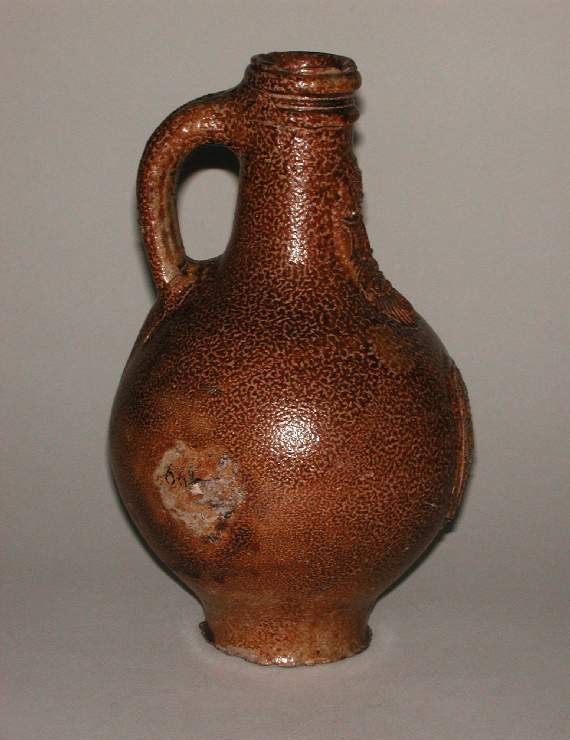
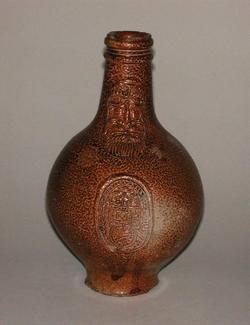
Brown salt-glazed stoneware with an applied bearded face mask on the neck and below an applied oval medallion containing a flower, a rectangle and a cartoucbe
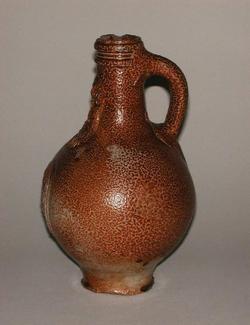
Grey stoneware with applied moulded mask, iron-brown wash and salt-glaze. The bottle has a bulbous body contracting into a narrow cylindrical neck with cordons at the top, and a small loop handle with two vertical grooves. A crude bearded face mask is applied on the front of the neck, and below is an oval medallion enclosing a formal flower, a rectangle containing triangles and spots, and an oval cartouche. There is a large scar on one side.
Legal notes
Dr J.W.L. Glaisher Bequest
Measurements and weight
Diameter: 12.9 cm
Height: 20.8 cm
Acquisition and important dates
Method of acquisition: Bequeathed
(1928-12-07)
by
Glaisher, J. W. L., Dr
Dating
17th Century
Circa
1600
-
1699
Note
The German term for salt-glazed stoneware jugs with a bearded mask on the neck is Bartmannkrug (bearded man jug). Workshops in Cologne, and Frechen, made them in vast quantities during the six¬teenth and seven¬teenth centuries. They were made in different sizes for domestic or commer¬cial purposes, and were expor¬ted widely. Dutch merchants shipped them to England, where they became known as `grey beards', or `Bellar¬mines' reputedly after Cardinal Roberto Bellarmino (1542-1621) whose reforming zeal made him unpopular in Prot¬estant states. The term was first mentioned in William Cartwright’s comedy 'The Ordinary, (1634).Some of the jugs are decorated with a medallion enclosing the coat-of-arms of a town, duchy, or family, or a merchant's mark.
Components of the work
Surface
composed of
iron-brown wash
( or 'dip')
salt-glaze
Base
Diameter 6.1 cm
Body
Decoration
Materials used in production
Stoneware
References and bibliographic entries
Related exhibitions
Identification numbers
Accession number: C.2018-1928
Primary reference Number: 76573
Old object number: 662
Stable URI
Audit data
Created: Saturday 6 August 2011
Updated: Tuesday 26 March 2024
Last processed: Tuesday 15 July 2025
Associated departments & institutions
Owner or interested party:
The Fitzwilliam Museum
Associated department:
Applied Arts