Current Location: In storage
Maker(s)
Production:
Unidentified Bunzlau pottery
Entities
Categories
Description
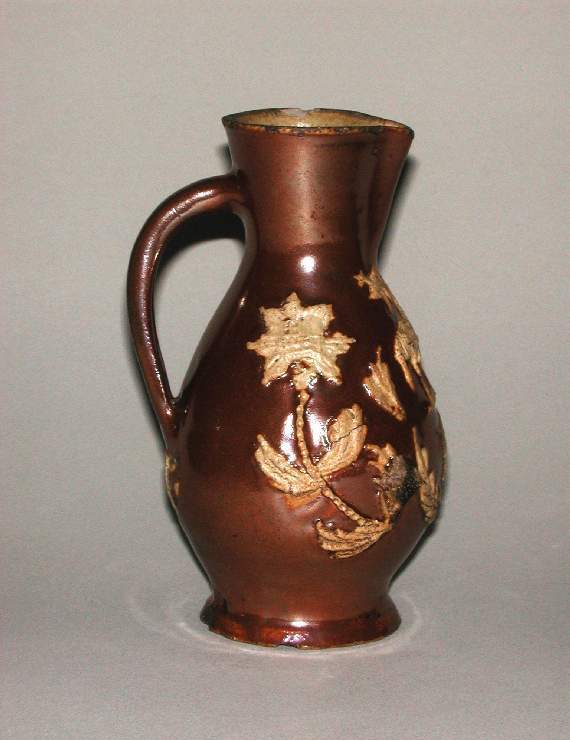
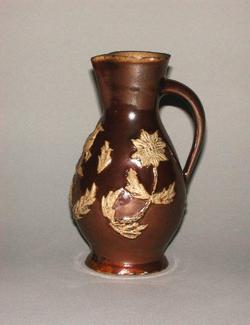
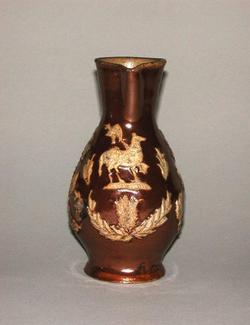
Buff stoneware with overall lustrous brown glaze, and applied off-white clay reliefs of the Paschal Lamb or Agnus Dei, palm fronds, foliage, and floral sprays
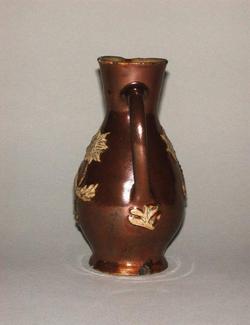
Buff stoneware, thrown with applied handle, overall lustrous brown glaze (Lehmglasur), and moulded and applied off-white clay reliefs. The jug has a pear-shaped body contracting into a short funnel-shaped neck pinched at the front to form a lip, and a narrow loop handle. On the front are applied reliefs of the Paschal Lamb or Agnus Dei, with palm branches below, and on either side, a small foliage motif, and a larger stem bearing two leaves and a star-shaped flower.
Notes
History note: Said by the vendor to have been acquired at a Jagdschloss in the Egerland in Bohemia; bought on 28 August 1910 at a stall near the Egerlander Café at Marienbad, belonging to Reinhold Entzmann and Son, Seidenerstate/Seilerstäte 21 Vienna for 10 Kroner (8/6) by Dr J.W.L. Glaisher, FRS, Trinity college, Cambidge.
Legal notes
Dr J. W. L. Glaisher Bequest
Measurements and weight
Height: 14.6 cm
Width: 9.2 cm
Acquisition and important dates
Method of acquisition: Bequeathed
(1928)
by
Glaisher, J. W. L., Dr
Dating
18th Century, second half
Circa
1750
-
1799
Note
Bunzlau in Silesia, became part of Prussia following the Peace of Breslau in 1742. It is now in Poland and known as Boleslawiec. Unlike much Germanic stoneware Bunzlau stoneware was not salt-glazed but had a lustrous brown glaze known as Lehmglasur
The relief of a lamb holding a flag was a religious symbol for the Paschal Lamb, which may represent either the sacrificial lamb of the Jewish Passover celebration, or Christ as the Lamb of God (in Latin the Agnus Dei) who was sacrified by Crucifixion.
School or Style
Rococo
Components of the work
Exterior
composed of
glaze
( lustrous brown, Lehmglasur)
Base
Diameter 5.7 cm
Body
Reliefs
Materials used in production
buff
Stoneware
References and bibliographic entries
Identification numbers
Accession number: C.2081-1928
Primary reference Number: 76597
Old object number: 3246
Stable URI
Audit data
Created: Saturday 6 August 2011
Updated: Monday 16 January 2023
Last processed: Tuesday 15 July 2025
Associated departments & institutions
Owner or interested party:
The Fitzwilliam Museum
Associated department:
Applied Arts